Thirty-five years after helping define what Sonic the Hedgehog sounds like, Masato Nakamura is still finding new ways to look at the music he wrote for SEGA’s blue hedgehog.
The DREAMS COME TRUE bassist and composer has looked back on the original Sonic the Hedgehog soundtrack in a substantial new interview for CONTINUE Vol.90, covering everything from the work he was doing before his professional debut to SEGA’s desire to challenge Mario, the worldwide reaction to Sonic and his later return to Green Hill Zone.
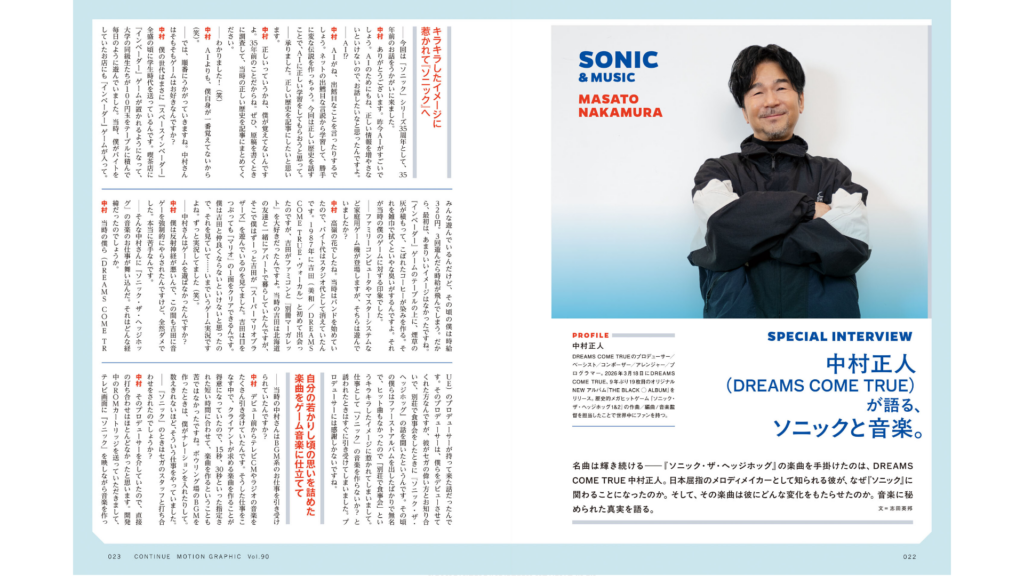
Before DREAMS COME TRUE made its debut, Nakamura was already making music professionally behind the scenes, particularly for television commercials and radio. That experience taught him how to work within strict requirements and very short running times.
“Before my debut, I took on a lot of music work for TV commercials and radio. Through those jobs, I got good at making the kind of music clients wanted, so composing to fixed short lengths like 15 or 30 seconds wasn’t difficult for me.”
When Sonic the Hedgehog came along, Nakamura says there was very little direct contact with the development team. Instead, he received a development ROM and composed while watching Sonic running through the game.
And it was the game itself that pulled the music out of him.
“The Sonic visuals were wonderful. They had this three-dimensional sense of light and shadow, and a feeling of speed that really tested your ability to follow motion. There were green fields, palm trees and towering rocks. You’d run across grasslands, through valleys, across deserts, and into mechanical worlds. I was pulled along by those visuals, and that’s how the music for Sonic came out of me.”
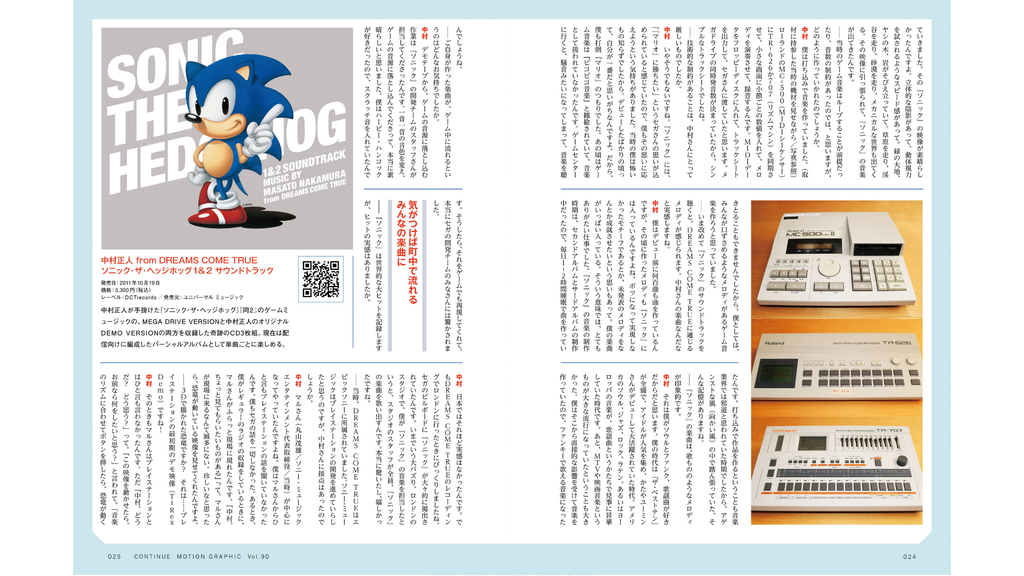
CONTINUE also photographs some of Nakamura’s equipment from the period, including a Roland MC-500MkII sequencer and TR-626 and TR-707 rhythm machines. Nakamura explains that he was programming the music through MIDI while working around the Mega Drive’s Yamaha FM sound hardware and its technical limitations.
Those limitations did not make him think small. Nakamura remembers feeling the competitive energy surrounding Sonic very clearly.
“I felt Sonic carried SEGA’s desire to beat Mario, so I wanted to respond to that too. Back then, I was fearless and thought we could beat any game. So I was approaching it with the idea of beating Mario as well.”
He was equally determined to push back against how game music itself was treated at the time.
“Back then, game music was mocked as ‘beep-boop music’ and wasn’t treated as music. I wanted to make music with melodies everyone could hum.”
The scale of what Sonic had become did not fully hit Nakamura until he travelled to London while recording with DREAMS COME TRUE. He recalls seeing Sonic displayed prominently on a SEGA billboard and then telling people at the studio that he had composed the game’s music.
The reaction caught him completely off guard. According to Nakamura, the studio staff immediately began singing Sonic melodies back to him.
That music has continued to follow him through the decades, particularly Green Hill Zone.
Nakamura later returned to the melody with DREAMS COME TRUE for Tsugi no Se~no! de – ON THE GREEN HILL –, and the CONTINUE interview reveals that the idea of using Green Hill for the Ito En collaboration actually came from Nakamura himself.
“I suggested it to the person in charge at Ito En, and they let us make it. I felt it became a really good tie-in for them too, but what started it was my ulterior motive of wanting to dig up treasures I had made in the past.”
For Nakamura, revisiting those “treasures” is not simply about recycling old music. He talks about older works containing ideas that can reveal something different when they are placed in a new context decades later.
That thinking has even led him to consider going considerably further with his original Sonic catalogue.
“I had actually thought about trying to add lyrics to all of Sonic’s music, but part of me also feels the originals may be better left as they are. I don’t know what will happen from here, though.”
There is a practical reason for his hesitation too. Nakamura says that, from a music-business perspective, the original Sonic the Hedgehog 1 & 2 Soundtrack can sometimes receive more streams than Tsugi no Se~no! de – ON THE GREEN HILL – itself.
In other words, the 35-year-old originals are doing just fine without anybody finishing the job for them.
Nakamura closes the interview by putting his own contribution into perspective. Despite creating some of the most recognizable music in the franchise, he credits the people who continued building Sonic long after his work on the first two games was finished.
“I only participated in a tiny part of Sonic’s long 35-year history, and you could say I just made the music. I think where we are now exists because everyone at Sonic Team kept making games, never let the flame go out, and grew it into an even bigger fire.”
Thirty-five years later, that fire now includes games, films, concerts, remixes and generations of musicians who grew up with Nakamura’s melodies. Green Hill may have been written for a Mega Drive game in 1991, but Nakamura clearly has not finished thinking about what those songs can still become.
Stay tuned to Sonic City for more Sonic Music News and Updates!
Discover more from Sonic City ⋆★ Sonic the Hedgehog News, Media, & Community ★⋆
Subscribe to get the latest posts sent to your email.