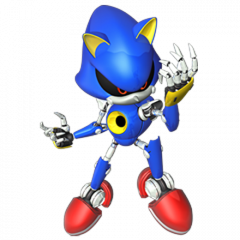
The artist behind Sonic 3 & Knuckles’ Mecha Sonic Mk. II has no plans to give the character a modern redesign.
In a September 5 interview conducted by Ashley Rojas for Sega Retro, former SEGA artist Satoshi Yokokawa was asked whether he would create a new, detailed character sheet for Mecha Sonic Mk. II using his present-day art skills.
He declined, saying the original low-resolution sprite remains the version he considers the “correct answer.”
“It’s a very kind offer, but I’d like to decline this time. For me, there’s a feeling that the ‘correct answer’ for Mk. II lies in the in-game design I created back then. And precisely because it’s low-resolution, I find the current situation, in which all of you freely expand your ideas from it and develop the design, very gratifying.”
Yokokawa added that producing his own modern interpretation could influence the way other artists approach the character.
“Taking into account the possibility that a new design of my own might influence that flow, I’d prefer to refrain from redesigning it anew with my own present-day sensibility, if possible.”
Yokokawa joined SEGA in 1991 and was later sent to the United States to work on Sonic the Hedgehog 3 at Sega Technical Institute. He recalled that the assignment came about after other candidates had declined an overseas transfer.
“The department head explained, with a smile, that there was a quota for how many people the department had to send, that every candidate he’d approached before me had declined, and that there were no candidates left besides me.”
At STI, Yokokawa was responsible for all enemies, mini-bosses and main bosses in Sonic 3 and Sonic & Knuckles, covering their designs, graphics and associated effects. He also created the graphics for Chrome Gadget in Competition Mode.
His enemy designs were built around the situation following Sonic the Hedgehog 2. With the Death Egg damaged after crashing onto Angel Island, Yokokawa imagined Eggman working with damaged production facilities and assembling machines from whatever parts were available.
“I arrived at the idea that Dr. Eggman, needing a fighting force to oppose Sonic under conditions where the production facilities weren’t functioning properly, would gather up usable parts and hastily assemble machines to deal with the situation.”
That idea led to visible bolts, screws, corrugated plating and exposed pipes across the game’s mechanical enemies.
Yokokawa also cited the Amiga version of Fatal Rewind: The Killing Game Show as an influence on the metallic surfaces and reflected light used in Sonic 3’s enemy graphics.
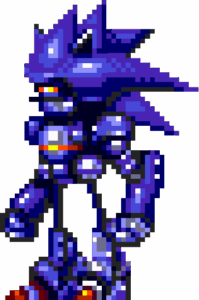
The name “Mecha Sonic Mk. II” was already being used internally during development, despite the name only becoming formally established much later.
“Within the development team we called it ‘Mecha Sonic Mk. II.’ I don’t clearly remember who first started calling it that, but I too recognized it by that name.”
The character’s physical design started with an unusual reference: a three-dimensional Sonic figure created for the original Sonic the Hedgehog television commercial that was kept in SEGA’s CS1 department.
Seeing the figure helped Yokokawa understand how Sonic’s spines were arranged in three dimensions. He then developed Mecha Sonic’s individual mechanical spines around the idea that they could close around the body during the Spin Attack.
“The starting point of the design, as I remember it, was the idea of arranging the spines as independent parts on the back and having them surround the body like an armadillo when spinning.”
Movement came from a different set of influences. Yokokawa pointed to the 1980s anime Armored Trooper Votoms and Blue Comet SPT Layzner when discussing Mecha Sonic’s ground dash and Super form.
The ground-dashing pose and sparks from the character’s feet were influenced by the AT machines from Votoms, while Super Mecha Sonic Mk. II’s aerial movement drew from the SPT machines in Layzner.
Yokokawa also explained the function of the glowing red component visible when Mecha Sonic opens its chest.
It is not an eye or brain, but an energy core used to absorb, store and release energy. The opening chest was designed to show Mecha Sonic taking energy directly from the Master Emerald during its transformation into Super Mecha Sonic.
The same core also serves as the muzzle for the energy projectiles fired in that form.
“The part that looks like a red eye is set as the energy core inside Mecha Sonic Mk. II… This core also functions as the muzzle from which the energy bullets are fired during Super Mecha Sonic Mk. II.”
The interview also clears up how much earlier Sonic robots influenced the character.
Yokokawa said he deliberately carried over some elements from the Mecha Sonic fought in the Mega Drive version of Sonic 2, including parts of the face, pointed feet and heel rollers. He considers the two separate robots rather than the same machine rebuilt.
Metal Sonic, however, had almost no influence on the design. Because Sonic CD was being developed in Japan while Yokokawa was working in America, he said he had very little information about the game and does not remember even being aware of Metal Sonic when Mecha Sonic Mk. II was being designed.
The character’s blue coloring was intentional from the concept stage. Yokokawa wanted it visually connected to Sonic while avoiding the more monotonous all-silver appearance of the earlier Mecha Sonic.
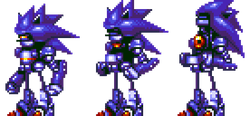
Yokokawa was also shown some of Mecha Sonic Mk. II’s later appearances during the interview, including IDW’s Scrapnik Island. He had not known about those modern interpretations beforehand, but praised the comic’s artwork and the way the original design had been adapted.
He was particularly pleased that artists were still developing ideas from a character he created more than 30 years ago.
That reaction ties directly into why he does not want to produce a definitive modern character sheet himself. For Yokokawa, the limitations of the Mega Drive sprite leave room for other artists to interpret details that were never explicitly shown.
“Mk. II was a particularly memorable presence for me even within ‘Sonic 3,’ so I’m very glad and grateful that its design has been received so favorably by so many people, and that it’s still being carried on and developed in various forms by fans even now.”
The full interview also covers Yokokawa’s work on the Giant Eggman Robot, Doomsday Zone boss, Chrome Gadget, his later move into 3D development, and projects including Skies of Arcadia, Gunstar Super Heroes and Bangai-O Spirits.
The complete interview conducted by Ashley Rojas can be read on Sega Retro.
Stay tuned to Sonic City for more Sonic the Hedgehog News and Updates!
Discover more from Sonic City ⋆★ Sonic the Hedgehog News, Media, & Community ★⋆
Subscribe to get the latest posts sent to your email.