Sonic Frontiers may have established the open-zone formula as a new direction for 3D Sonic, but Takashi Iizuka says getting there was the most difficult Sonic development he has experienced.
The Sonic series producer has been looking back across 35 years of the franchise alongside Kazuyuki Hoshino and Jun Senoue in the special long-form roundtable featured in CONTINUE Vol.90, and when the conversation turned to particularly difficult projects, Sonic Frontiers was Iizuka’s immediate answer.
“The most difficult one would be Sonic Frontiers,” he explained.
Interestingly, the problem was not coming up with the game’s broad concept.
Iizuka says the team settled relatively smoothly on the idea of letting Sonic play across a vast landscape. The real problem came immediately afterwards: figuring out what Sonic was actually supposed to do once he was there.
Previous Sonic games had always been built around routes. According to Iizuka, once the developers designed those routes, they could naturally create a fast and enjoyable experience around them.
Frontiers deliberately removed that safety net.
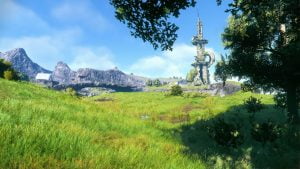
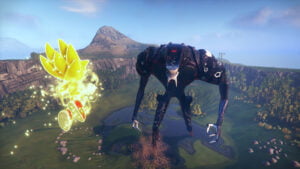
Instead of sending Sonic down a carefully constructed path, the team had created an enormous space without one. Suddenly, the developers had to answer a much more fundamental question: how do you make simply running around that space fun?
And at the beginning of development, they apparently did not know.
“We started the project without being able to see the right answer.”
Iizuka compares the situation directly to the original Sonic Adventure, another project where Sonic Team had to establish a new way for the character to work while actually building the game.
Rather than beginning Frontiers with a proven formula and expanding from it, the developers found themselves searching for that formula as production continued.
That search lasted a surprisingly long time.
“We couldn’t find the right answer until around the middle of the project.”
It is a pretty striking admission considering just how fundamental the open-zone format became to the finished game.
And Iizuka was not alone in remembering how difficult things became.
Hoshino, who was involved from a character-supervision position rather than directly developing the game, says he could still feel just how much the team was struggling from the outside.
“I could really sense that the people on the ground were having a hard time,” he recalled. “It was tough.”
The unusual development arrangement added another layer to the process.
While Sonic Frontiers was being developed in Japan under director Morio Kishimoto, Iizuka was working from America. He says Kishimoto was struggling considerably with the project, so the pair effectively worked together across the Pacific to figure out what the game needed to become.
One particularly important part of that process was repeated playtesting in the United States.
Iizuka says they conducted American playtests multiple times, took the results back to Kishimoto, and then worked together to determine what needed to change.
Rather than a single breakthrough arriving overnight, evaluations gradually improved as that process continued.
Iizuka describes the two of them moving forward “three-legged race” style, steadily working through the problems until the game began receiving better responses.
Ultimately, though, he gives Kishimoto the credit for getting Frontiers across the line.
Iizuka says it was only after Kishimoto finally found the solution that the project was able to properly take shape.
That fills in another part of a development story Sonic Team has been unusually open about over the years.
As Sonic City previously covered, Iizuka and Kishimoto revealed back in 2022 that Frontiers spent around five years in development and went through regular external playtests. One early prototype featured a much larger island packed with puzzle-oriented activities, but testers simply were not enjoying it.
The developers eventually realised that creating a large world was not enough. It still needed to feel unmistakably like Sonic.
This new CONTINUE discussion puts that earlier story into an even clearer perspective. The problem was not simply polishing an unfinished open zone. Sonic Team spent a substantial portion of development still trying to discover the basic answer to how Sonic should work in that kind of world at all.
Which makes the final result rather more significant.
Frontiers did not begin with the open-zone Sonic formula already worked out. According to Iizuka, the project began without that answer, was still looking for it around the middle of production, and only finally came together after years of experimentation between Kishimoto’s team in Japan and Iizuka’s side of the project in America.
For the man who has worked on Sonic games stretching all the way back to the Mega Drive era, calling it his most difficult Sonic development says quite a lot.
CONTINUE Vol.90 is available now in Japan and features Sonic’s first-ever cover appearance for the magazine, alongside the full 35th Anniversary roundtable with Iizuka, Hoshino and Senoue.
Stay tuned to Sonic City for more Sonic News and Updates!
Discover more from Sonic City ⋆★ Sonic the Hedgehog News, Media, & Community ★⋆
Subscribe to get the latest posts sent to your email.