Spoiler warning: This review discusses major story developments from Sonic the Hedgehog: Bad Guys #1-4 and Sonic the Hedgehog #33-40.
Sonic the Hedgehog: On the Go, Volume 4 is a slightly unusual collection.
Rather than following one continuous storyline from beginning to end, IDW has paired the complete four-issue Bad Guys miniseries with Sonic the Hedgehog #33-40, giving us twelve issues from roughly the same period of the comic.
And while that creates a fairly dramatic change of tone halfway through the book, it also makes this one of the more interesting On the Go volumes so far.
Because for its first third, Sonic is barely the star at all.
Dr. Starline is.
After his relationship with Dr. Eggman spectacularly falls apart, Starline decides that what he really needs is his own team. That leads him to Everhold Prison, where he begins assembling an absolutely disastrous collection of villains consisting of Zavok, Mimic, Rough and Tumble.
It is a brilliant group precisely because nobody involved should trust anybody else.
Starline sees himself as the mastermind. Zavok immediately gives off the impression that he is tolerating him only while the arrangement remains useful. Mimic is constantly looking for the safest possible exit. Rough and Tumble are, well, Rough and Tumble.
Starline tries to turn these people into a functioning criminal operation while handing out upgrades and Power Cores, and the resulting dynamic is consistently funny without turning any of them into complete idiots. The four villains are dangerous, but they are dangerous for completely different reasons.
That makes Bad Guys work much better than a straightforward “villains team up” story.
Starline is at his most entertaining when his intelligence and his ego are fighting each other. He is genuinely clever. His plans often make sense. He understands Eggman’s technology, knows how to manipulate people and can improvise when something goes wrong.
But he desperately needs everyone around him to recognise how clever he is.
And that weakness is sitting right underneath almost everything he does.
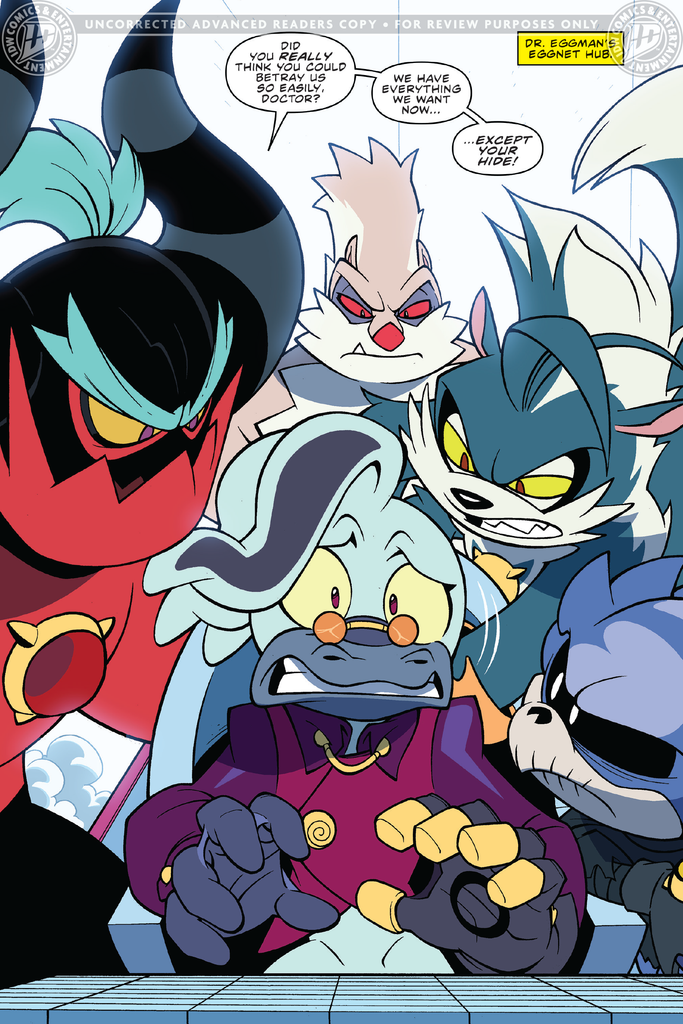
Zavok in particular is a great foil for him. Starline wants a subordinate, while Zavok behaves more like someone temporarily allowing Starline to believe he is in charge. Mimic works from an entirely different angle, quietly protecting himself while everyone else causes increasingly spectacular amounts of destruction.
Then you have Rough and Tumble smashing through whatever subtlety might still be left.
The result is some of the best villain chemistry IDW Sonic had produced at this point.
Jack Lawrence’s artwork is a huge part of why it works. His characters are enormously expressive, particularly Starline, who can go from smug superiority to complete panic in a couple of panels. Leonardo Ito’s colours also give the miniseries a bright, aggressive look that fits a story populated almost entirely by people with questionable impulse control. The collection credits Ian Flynn as writer of all four Bad Guys issues, with Lawrence handling the principal artwork.
The finale is equally satisfying because the group never suddenly becomes a wholesome team.
Everybody remains selfish.
Everybody has their own agenda.
And Starline ultimately moves forward convinced that his latest scheme proves he is getting closer to becoming the kind of mastermind he imagines himself to be.
The joke, of course, is that we have already spent four issues watching the cracks in that fantasy.
Then the book switches over to Sonic the Hedgehog #33, and it almost feels like somebody changed channels.
The colour palette becomes warmer. The heroes are back. There are Chao races, White Park, roller coasters and considerably fewer criminals plotting to stab one another in the back.
Coming directly after Bad Guys, the transition is abrupt.
But it is also refreshing.
These issues arrived after the enormous Metal Virus storyline, and there is a noticeable desire to give the cast room to breathe again. Sonic gets to have fun. Tails gets to tinker. Amy, Cream and Rouge can attend a Chao race without civilisation immediately collapsing around them.
Naturally, civilisation still manages to get itself into trouble.
The White Park material gives the book some wonderfully colourful pages, and the race itself is exactly the kind of smaller-scale Sonic story that works well after a major saga. Meanwhile, Sonic and Tails’ investigation of abandoned Eggman facilities begins pulling the larger plot back into focus.
That is where Belle becomes increasingly important.
Initially, there is something deliberately awkward about her. She clearly does not belong among Eggman’s machines, but everything about her construction says that she came from somebody with an intimate understanding of his technology.
Belle herself doesn’t have the answers.
What she does have is absolute faith in the person she remembers as her creator.
And the longer the volume goes, the more uncomfortable that becomes.
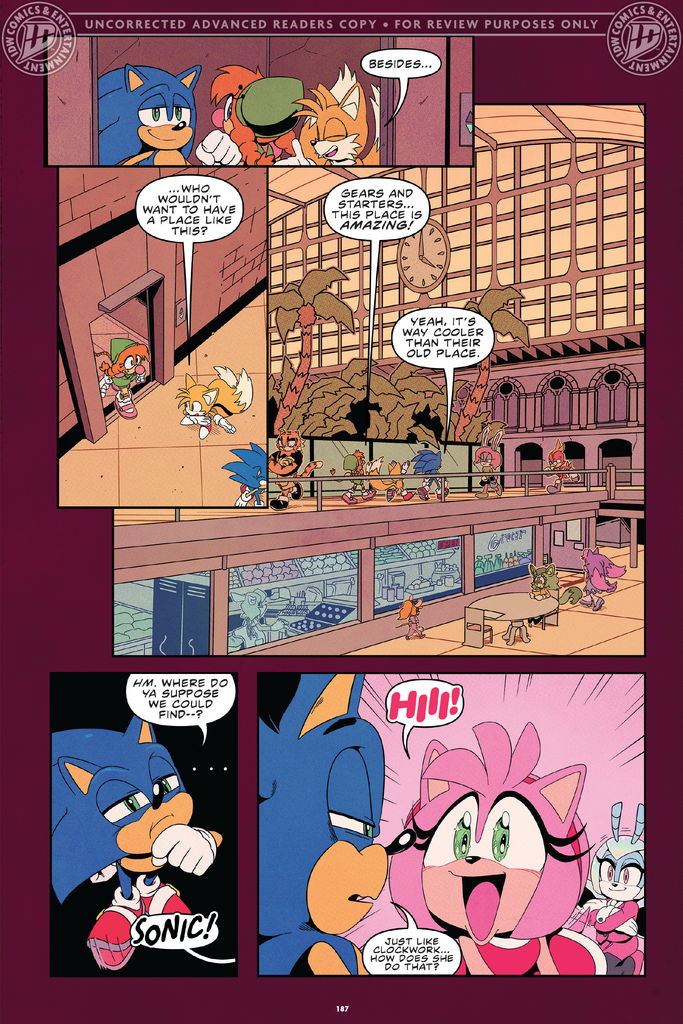
Belle is easily the strongest emotional thread running through the second half of this book.
Her search could very easily have been treated as a simple mystery, but the interesting part is not really figuring out who built her. The reader can get there considerably earlier than Belle does.
The interesting part is what that answer means to her.
Mr. Tinker was real.
He was kind, gentle and capable of creating something like Belle because he genuinely cared about doing so.
He was also Dr. Eggman.
Those two facts have to coexist.
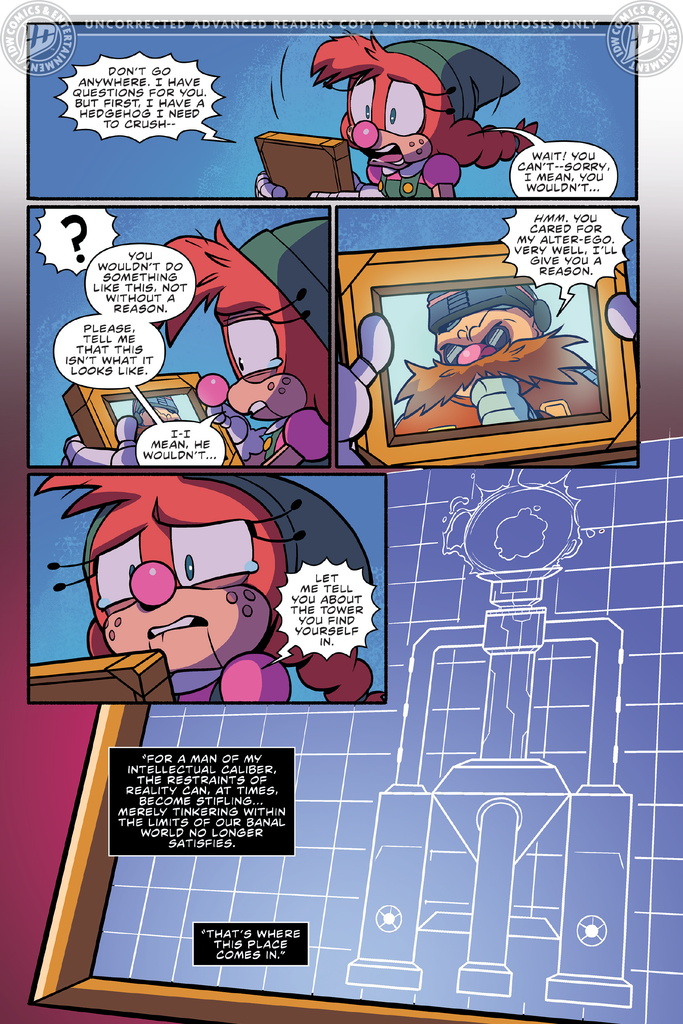
That finally becomes impossible for Belle to avoid when she finds a recording of Eggman and hears him recognise her. Eggman remembers exactly who she is. He remembers building her while living as Mr. Tinker, even joking about having been a “small-town inventor” while in that state.
He then asks what Mr. Tinker called her.
Belle can barely get the words out:
“B-Belle. Belle the Tinkerer.”
It is one of the best moments in the entire collection.
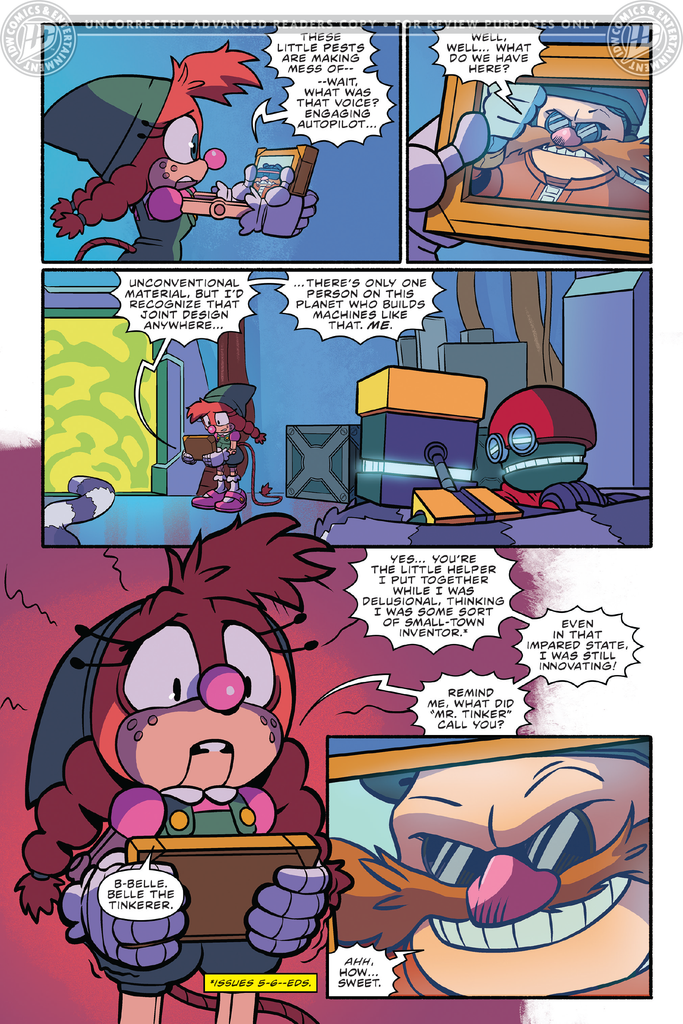
The scene works because Eggman does not suddenly become sentimental.
For Belle, this is confirmation that the father figure she remembers really did exist.
For Eggman, it is an embarrassing chapter of his life that happens to contain some interesting engineering.
That difference is brutal.
Belle wants some evidence that the man she loved is still somewhere inside him. Eggman responds by casually moving on to plans for another grotesque technological experiment.
The comic doesn’t need somebody standing beside Belle explaining why this hurts. Her expression does the work.
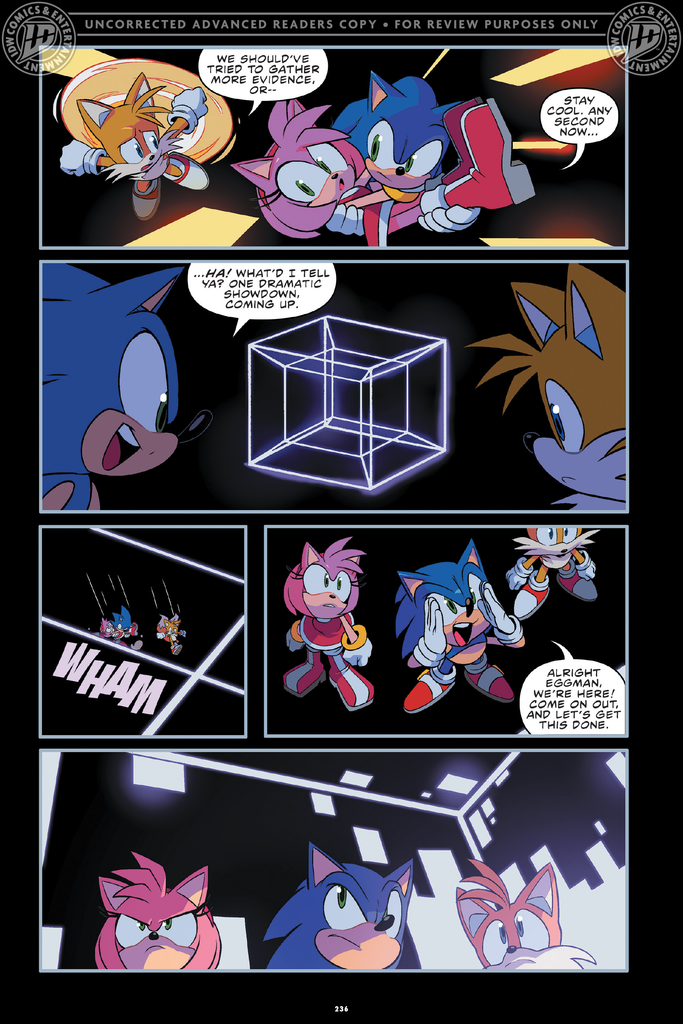
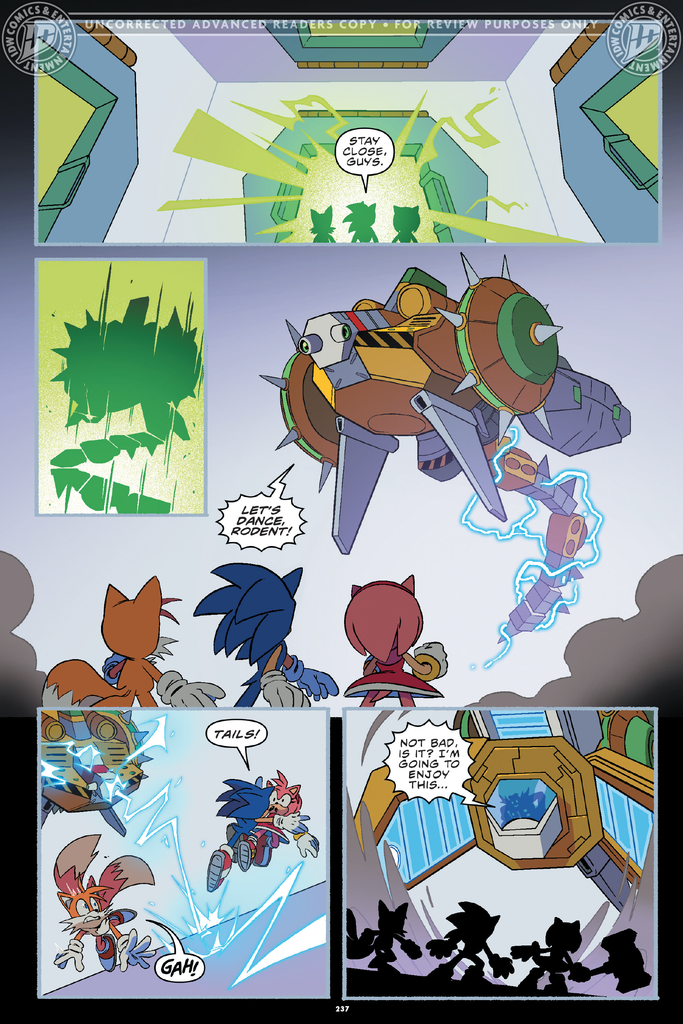
From there, Eggman’s increasingly elaborate testing facility gives Sonic, Tails and Amy an excuse to run through a series of ridiculous environments and combat scenarios while Belle, Tangle and the others work through the machinery surrounding them.
There is a lot to enjoy here.
Amy gets some particularly good action. Tails repeatedly has to figure out the logic behind environments that deliberately stop behaving logically. Sonic spends most of the ordeal treating another one of Eggman’s deathtraps like a particularly inconvenient obstacle course.
And Eggman is having the time of his life.
Some of his simulated environments are wonderfully absurd, especially once the heroes realise the place is effectively one enormous test bed. Rooms transform, gravity stops cooperating, Badniks appear in strange combinations and the whole facility behaves like Eggman was given unlimited resources and told to make the world’s most irritating laboratory.
This is also where the book becomes slightly less consistent.
Bad Guys has a very clear four-issue purpose. It knows who its central character is, what he wants and why his team is inevitably going to implode.
The eight regular-series issues are much broader.
There is White Park. There is the Chao race. There is Shadow. There is the Restoration. There is Belle’s creator mystery. There are multiple abandoned Eggman facilities. There is an extended testing-ground sequence. There are several groups of characters operating separately before their stories reconnect.
Most of those pieces are good.
They do not always feel equally essential.
The middle portion in particular can occasionally feel like connective tissue between bigger ideas. There are stretches where the plot is moving characters into position rather than delivering something as focused as the Starline material.
That does not make the issues bad, but it does keep the collection from feeling completely cohesive.
Thankfully, Evan Stanley and the rest of the art team give the regular series plenty of personality even when the story slows down. The volume moves between several artists, including Stanley, Adam Bryce Thomas, Bracardi Curry and others, while still maintaining a recognisable IDW Sonic identity.
The character acting is particularly good.
Sonic has that effortless confidence without feeling invincible. Amy is energetic without being reduced to “girl with hammer.” Tails gets to actually think his way through problems. Tangle brings chaos into practically every room she enters.
Belle, meanwhile, frequently looks like somebody trying desperately to convince herself that everything is going to be fine.
That consistency in the character work carries the quieter issues.
There is also something quite satisfying about reading these stories together in 2026.
Starline spends Bad Guys trying to prove that he understands Eggman better than anybody else.
Belle spends much of the regular series trying to understand the completely different person Eggman briefly became.
One character idolises Eggman so much that he wants to surpass him.
The other loved the version of Eggman that existed when almost everything recognisably “Eggman” had disappeared.
Neither gets the answer they actually want.
That connection probably was not the reason these twelve issues were packaged together, but it gives the collection a surprisingly strong thematic backbone.
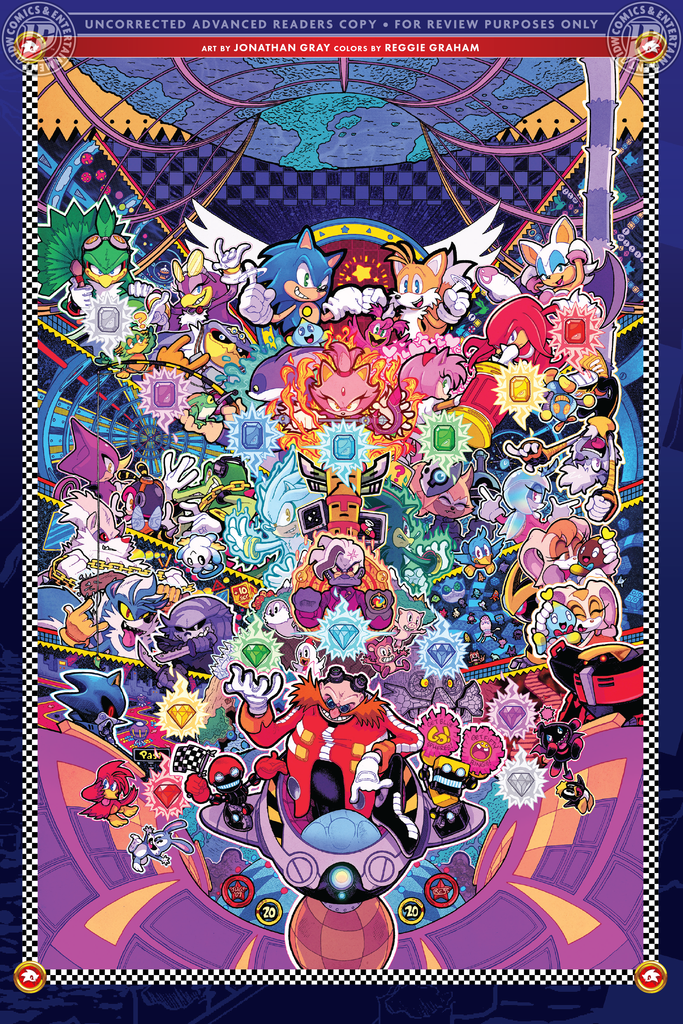
The physical collection also doesn’t stop with the stories. There is a substantial gallery of artwork at the back, including pieces from Jack Lawrence, Bracardi Curry, Gigi Dutreix, Jamal Peppers, Jonathan Gray, Reggie Graham, Thomas Rothlisberger, Dan Schoening and Evan Stanley.
Some of those pages are gorgeous.
So, no, Sonic the Hedgehog: On the Go, Volume 4 is not perfectly even.
The Bad Guys miniseries is the star of the book, and the regular Sonic issues take longer to find the same level of focus.
But when this collection hits, it really hits.
Starline gets one of his best showcases. Zavok, Mimic, Rough and Tumble are an entertainingly dysfunctional disaster. Sonic and his friends finally get some breathing room after the Metal Virus saga. And Belle’s confrontation with the truth about Mr. Tinker gives the second half an emotional payoff that is much stronger than the lighter opening chapters initially suggest.
Most importantly, at 282 pages, this actually feels like a substantial collection rather than a handful of issues bundled together. It gives you complete arcs, meaningful character development and plenty of artwork after the final story.
It may not be the most consistent IDW Sonic collection, but there is a lot here worth revisiting.

Bad Guys is the standout, with Dr. Starline and his spectacularly dysfunctional villain team carrying the strongest material, while Belle’s search for Mr. Tinker gives the second half its emotional core. Some of the regular-series material meanders, but this is still a substantial and rewarding collection.
Reviewed from an uncorrected advance copy supplied for review by IDW Publishing. Sonic the Hedgehog: On the Go, Volume 4 is scheduled for its first printing in October 6th, 2026. Cover art by Evan Stanley.
Discover more from Sonic City ⋆★ Sonic the Hedgehog News, Media, & Community ★⋆
Subscribe to get the latest posts sent to your email.