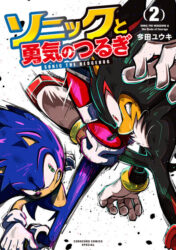
Pairing Sonic the Hedgehog with the slowest kid in the world sounds like the setup to a joke.
To be fair, Sonic the Hedgehog: The Blade of Courage gets plenty of jokes out of it. But by the end of its oversized first chapter, Yuki Imada has turned that contrast into something considerably more meaningful, delivering a genuinely charming introduction that understands Sonic remarkably well while giving his new human companion a reason to exist beyond simply being the kid who gets dragged along for the adventure.
Chapter 1, appropriately titled “Sonic the Hedgehog and Yuta the Slowpoke,” introduces Yuta in probably the worst afternoon an elementary school student could reasonably expect to have. A bank robber takes him hostage during his escape, only for Sonic to appear alongside the getaway motorcycle and immediately decide that the sensible response is to challenge the criminal to a race. It is a wonderfully efficient Sonic introduction. There is no grand entrance or lengthy explanation of who he is. He sees trouble, inserts himself into it and spends most of the encounter looking like he is having far too much fun.
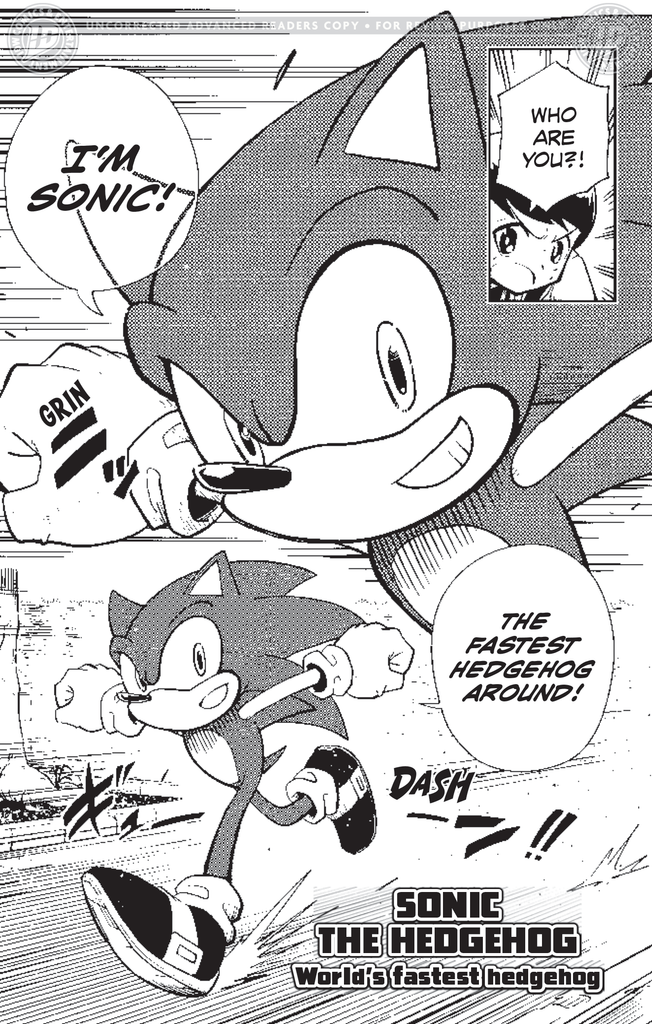
That first chase also tells us a lot about how Imada is writing Sonic. He is cocky without being obnoxious, reckless without being uncaring and constantly looking for an excuse to turn whatever is happening into something fun. Even after rescuing Yuta, his immediate reaction to the boy complaining that Sonic nearly got him killed in the process is essentially: come on, that was exciting, right? A little later he disappears in the middle of a crisis because he was hungry and wanted a chili dog. Of course he did.
More importantly, though, when somebody actually needs help, Sonic never hesitates.
And that is where Yuta comes in.
At first, the whole “slowpoke” thing appears to be nothing more than the standard nickname schoolkids have saddled him with. His classmates mock him for being slow, Yuta clearly hates it, and Sonic initially seems amused by the idea that somebody could carry around the title of “slowest kid in the world.” Then the manga quietly starts showing us why Yuta is always behind everyone else.
He stops to carry something for an elderly woman. He finds a baby’s lost shoe and takes the time to leave it somewhere the family can spot it. Then, when Sonic asks what exactly he is doing, Yuta gives us the line that basically defines his entire character: if he walked past somebody who needed help, that could really ruin their day.
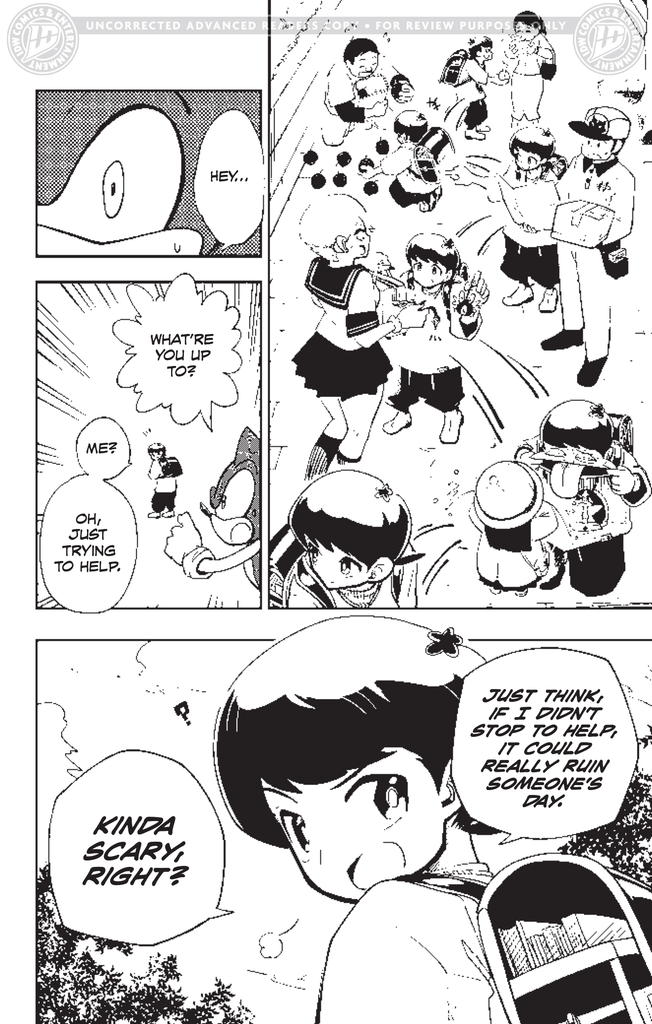
That is a much better answer than “he is slow because he is clumsy.”
Yuta is slow because he keeps stopping.
It is such a simple character idea, but it gives the manga’s central speed contrast an actual point. Sonic moves through the world faster than anybody else. Yuta moves through it more slowly because he notices the people around him. Neither approach is presented as inherently better, and the chapter spends the rest of its runtime finding a way to make those two philosophies work together.
There is also, obviously, a sword.
Yuta has been entrusted by his grandfather with the mysterious Blade of Courage, a strange little weapon connected to an old legend about a kingdom facing disaster. According to the story, a hero once appeared with the blade and defeated the threat, while the weapon is said to respond when wielded by somebody with sufficient courage and “halt any foe.” Yuta quite reasonably assumes that this probably has nothing to do with him.
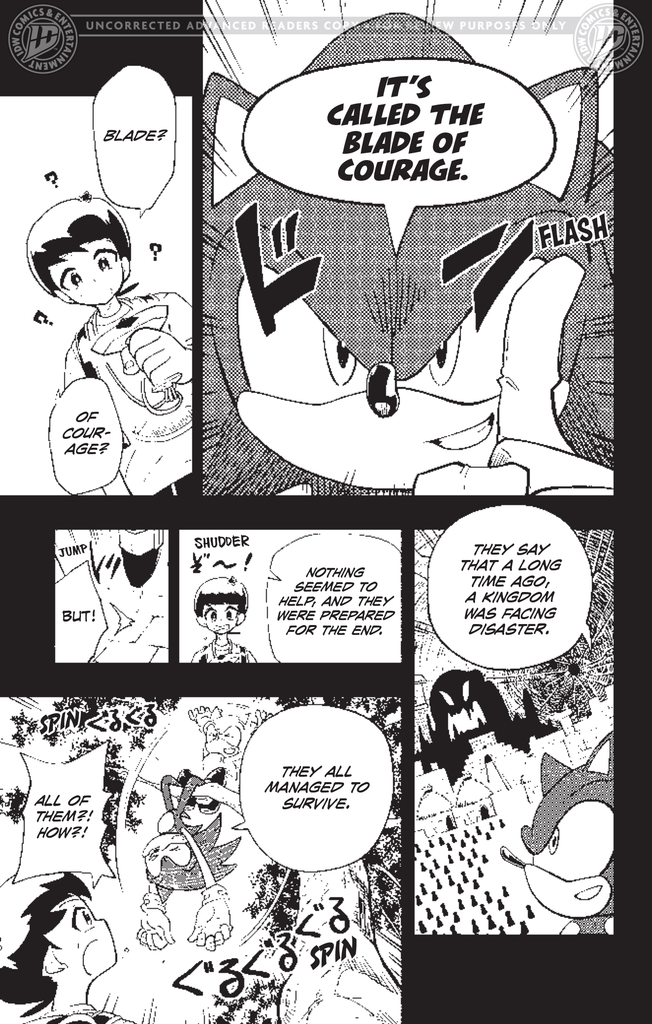
Then the bank robber from earlier returns.
Yes, apparently getting humiliated by a blue hedgehog once simply was not enough character development for this man.
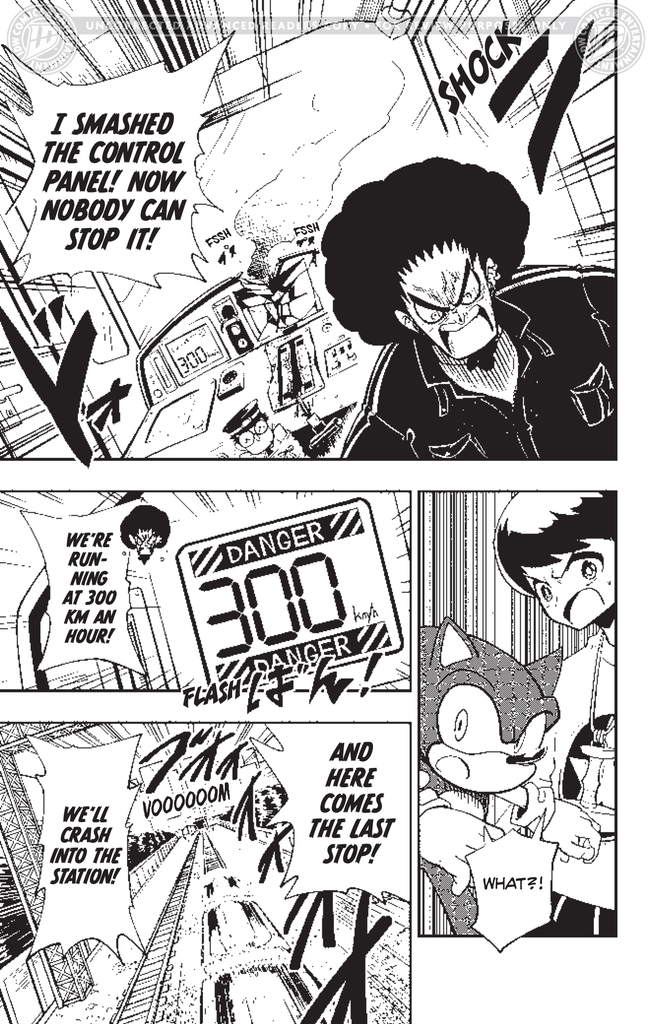
This time he hijacks a train, takes its passengers hostage and ultimately destroys the controls, sending the thing hurtling toward its final station at 300 kilometres per hour. Sonic does what Sonic does, racing through the carriages and evacuating the passengers one by one before discovering a slightly inconvenient problem: being faster than a train does not mean you can physically stop several tonnes of metal travelling at full speed.
This entire sequence is where the chapter really comes alive visually. Imada’s artwork has already been energetic during Sonic’s earlier race against the motorcycle, but the train climax gives the manga room to go properly wild with its speed lines, perspective and huge panels. Sonic practically tears through the carriages while carrying passengers outside, the train becomes this enormous wall of momentum behind him, and once he eventually plants himself in front of the thing, you can practically feel the rails complaining.
The actual solution, however, belongs to Yuta.
Sonic realizes that he cannot stop the train at its current speed, but if somebody could slow it down first…
Hmm. Where could we possibly find somebody whose entire thing is being slow?
Yuta is terrified. More than that, he genuinely does not believe he qualifies to use a weapon called the Blade of Courage. The kid has spent the entire chapter being told that he is too slow, and internally he has added another label of his own: coward. He is scared when people are in danger. He worries constantly. He hesitates.
Sonic sees the obvious problem with that assessment.
Yuta repeatedly goes out of his way to help strangers. He puts himself in danger to protect people. During the train crisis, he even tells Sonic to rescue somebody else before worrying about him. Being afraid has never actually stopped him from caring about somebody else.
That is courage.
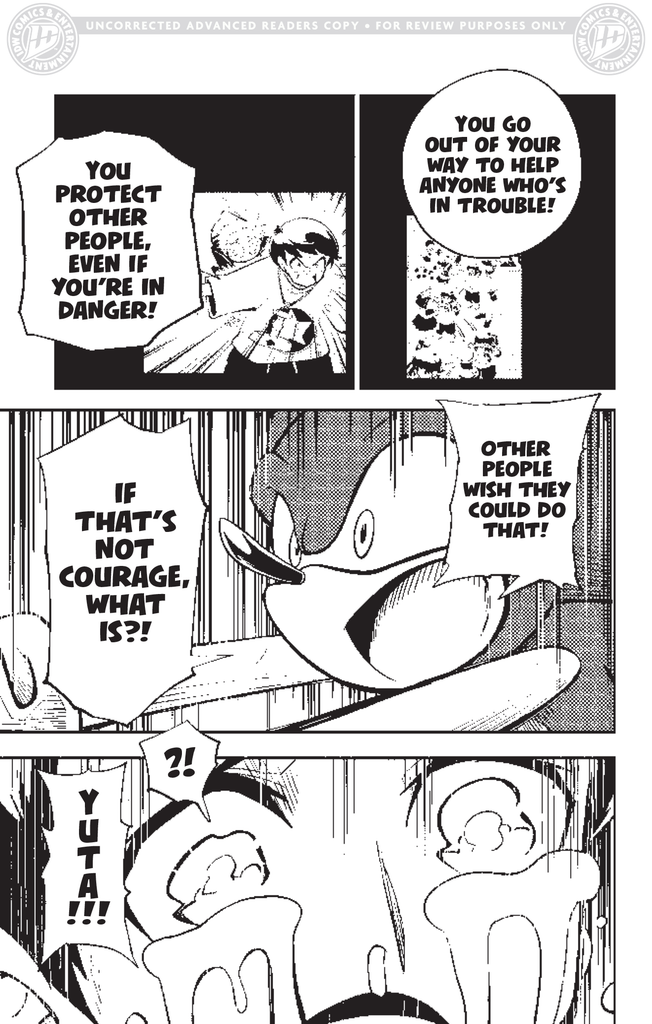
It is probably the best moment in the chapter because it understands something very basic about bravery that stories aimed at younger readers often muddle: being courageous does not mean you are never scared. Yuta is scared constantly. Courage is what he does despite that.
The Blade finally responds, transforming into a blade of light, and we learn what “halt any foe” actually means. Anything Yuta strikes with the weapon is slowed down.
And suddenly the entire premise clicks into place.
The fastest hedgehog alive has teamed up with a kid whose magical ability is basically making things slower.
That is fantastic.
Yuta cuts the runaway train and brings its speed down far enough for Sonic to finally do something about all that momentum. What follows is easily Imada’s strongest artwork in the chapter, with Sonic planting himself against the train and being driven backward as the wheels scream against the rails.
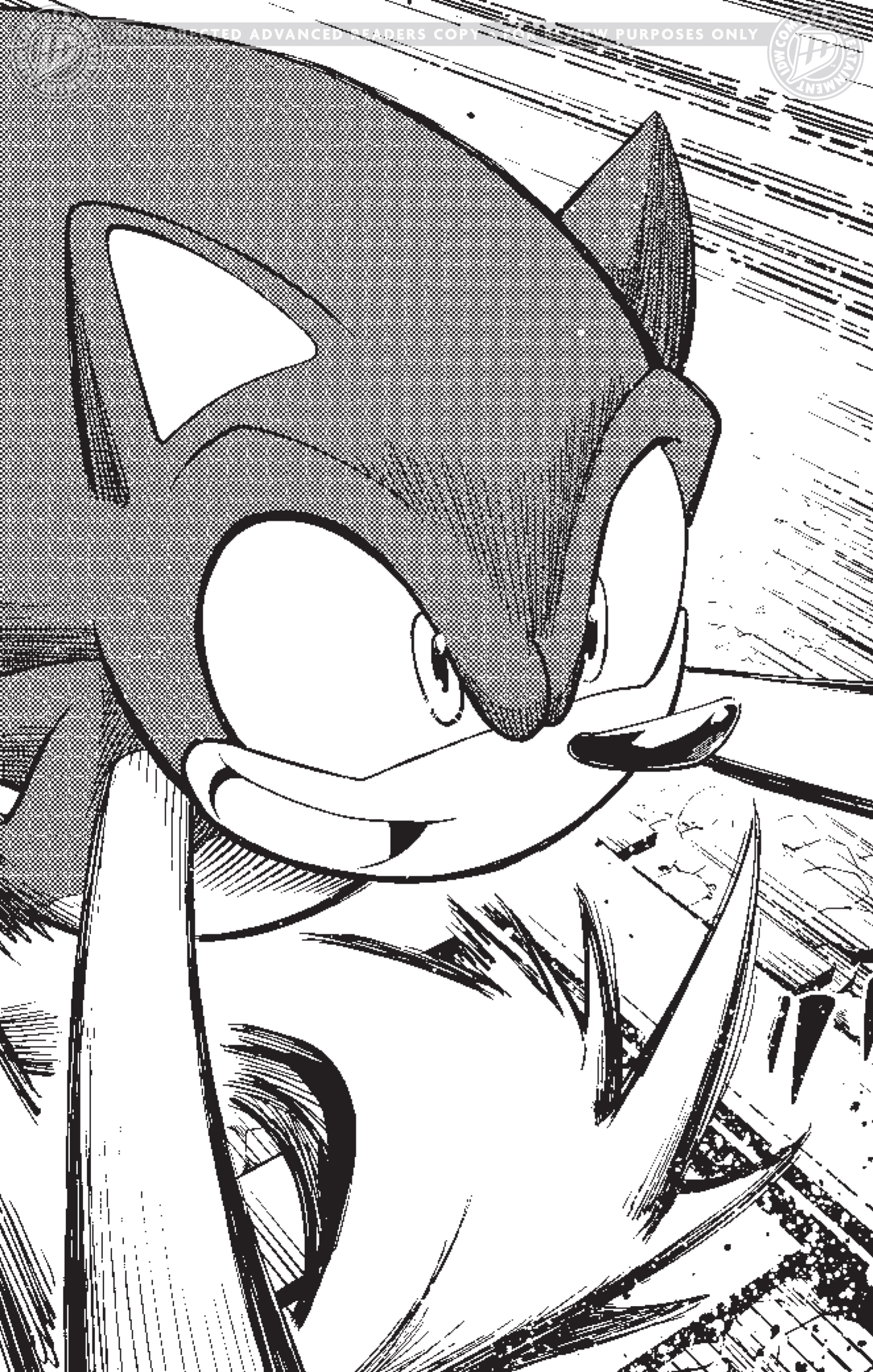
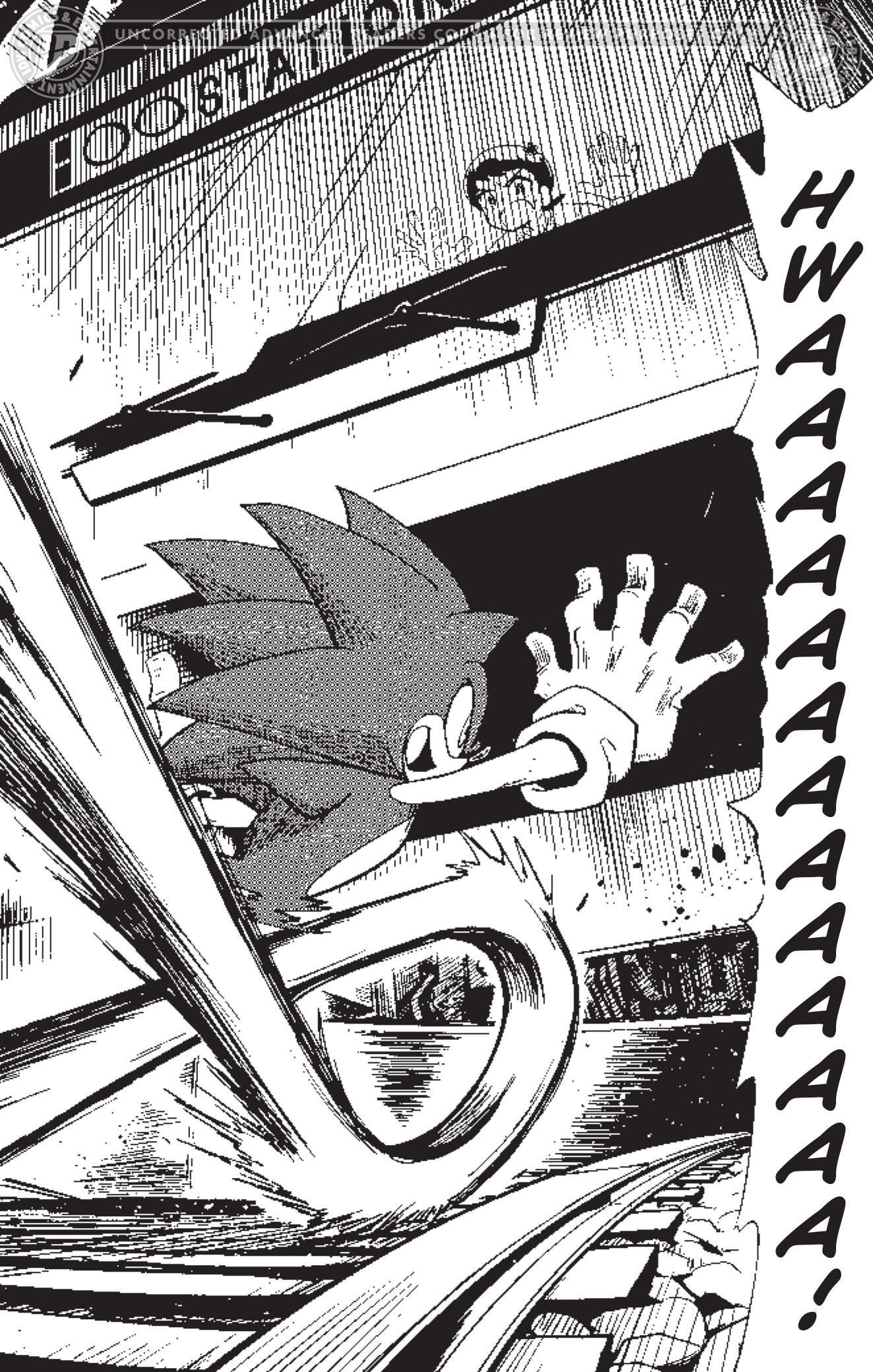
If you only want one climax image, though:
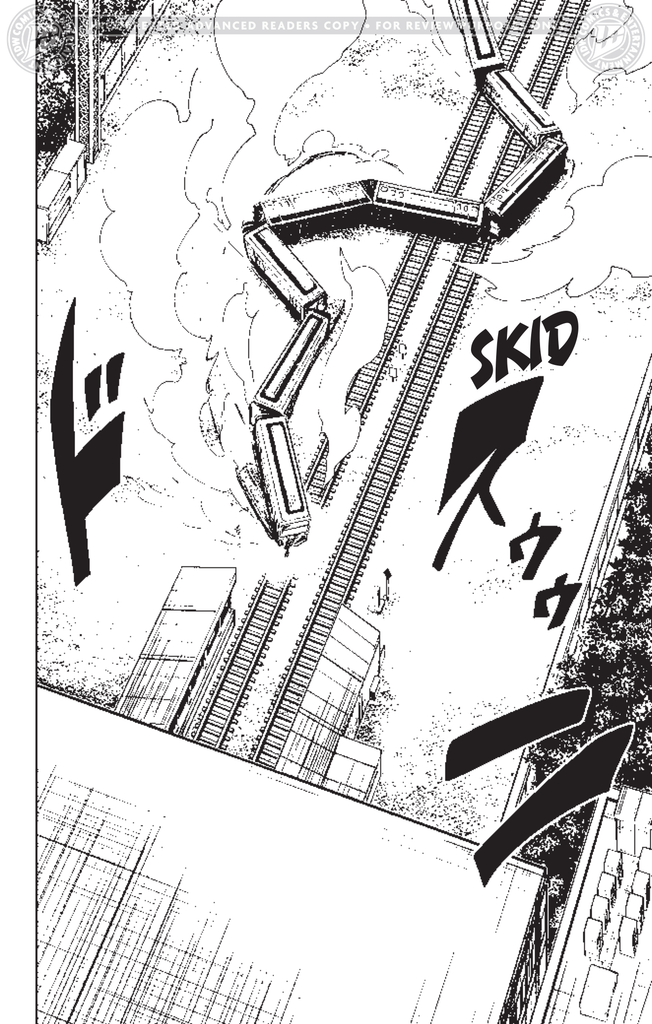
The important part is that neither character could have solved the problem alone. Yuta cannot completely stop the train. Sonic cannot overpower it at 300 km/h. Yuta slows it enough for Sonic to stop it.
Fast and slow.
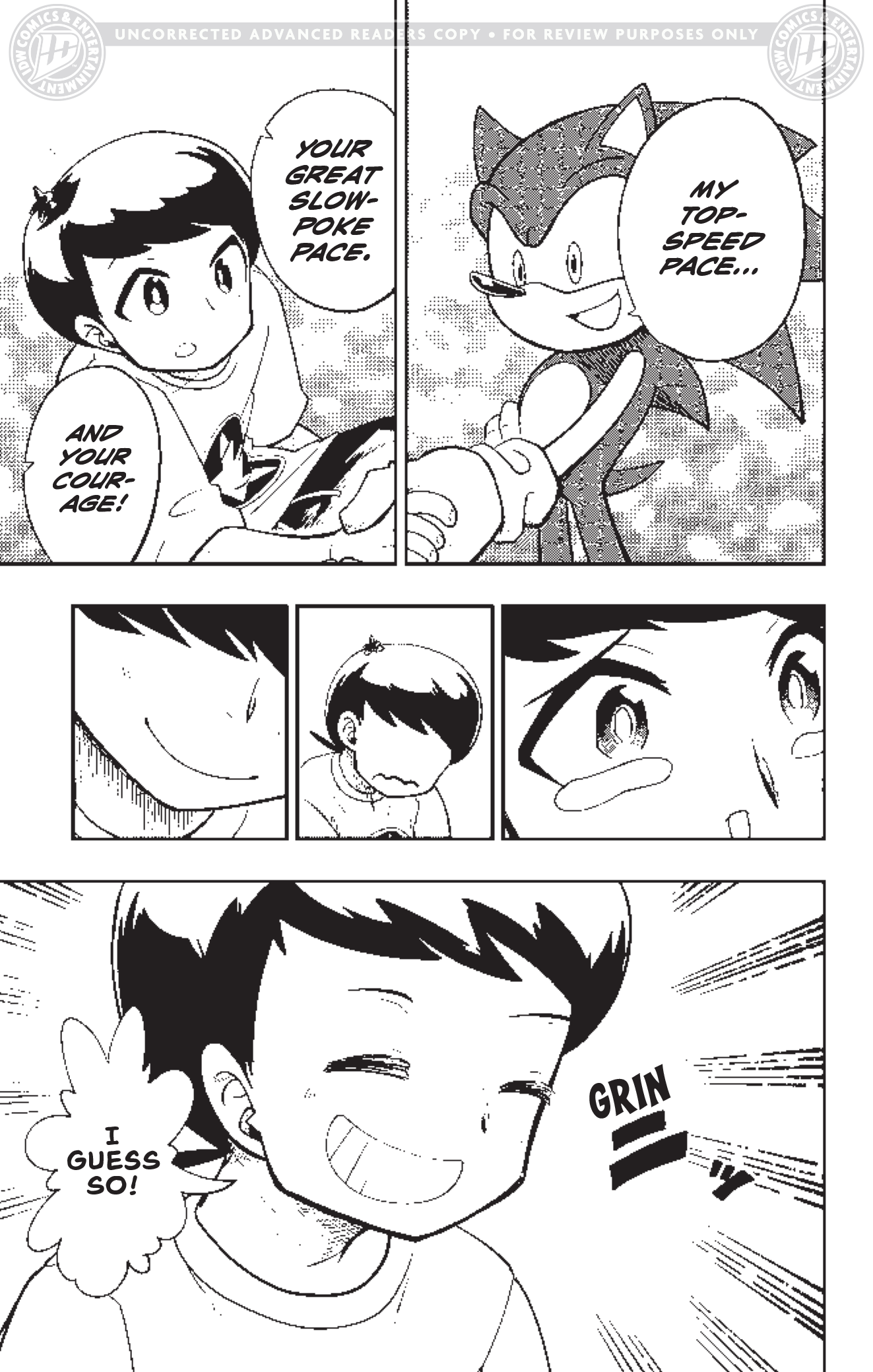
And rather than concluding that Yuta now needs to become quicker, Sonic tells him that they saved everybody because they were both able to move at their own speeds. Sonic has his top-speed pace. Yuta has his “great slowpoke pace.” The insult that bothered Yuta throughout the chapter has effectively been reclaimed as something he can be proud of.
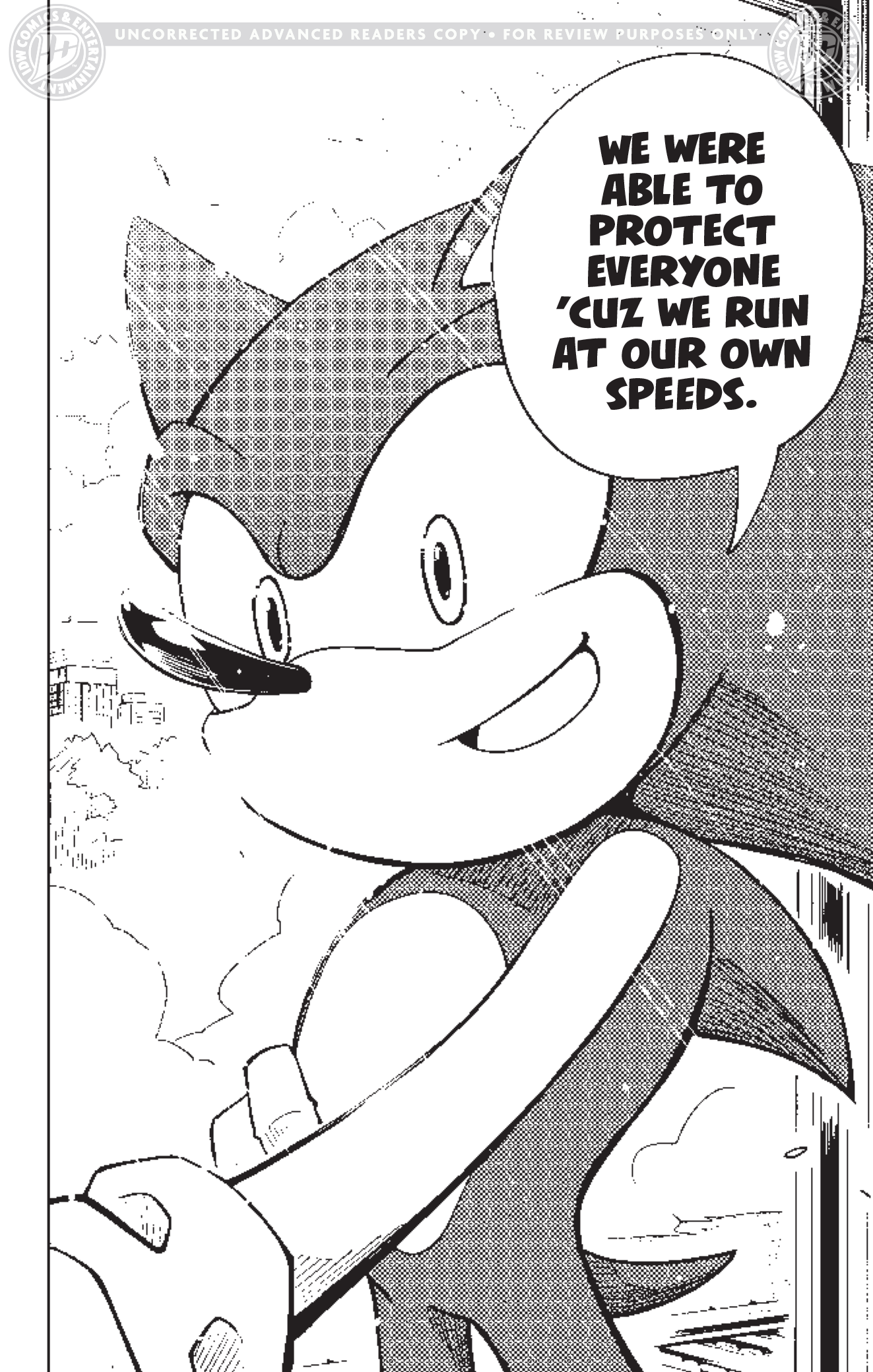
It helps that Imada has a really solid handle on Sonic himself. There is a temptation whenever Sonic gets paired with a younger human character to turn him into either a mentor delivering constant life lessons or a hyperactive mascot bouncing around while the human does all the emotional heavy lifting. This chapter avoids both. Sonic is still Sonic. He jokes, races things, eats chili dogs and causes trouble because standing still apparently causes him physical discomfort, but he also understands Yuta almost immediately.
He does not sit Yuta down for a lengthy motivational speech. He simply sees what the kid is already doing and tells him to stop selling himself short.
The first chapter is not perfect. The robber is barely a character at all, serving mostly as a loud human obstacle who somehow keeps stumbling into increasingly elaborate crimes, and the opening half can feel a little episodic before the train sequence gives everything a stronger sense of direction. The humour is also unmistakably aimed at a younger readership, so your mileage may vary on just how many giant reaction faces and screaming criminals you need in your Sonic manga.
But those are fairly minor complaints when the central character work lands this well.
And the story wisely does not end with the train.
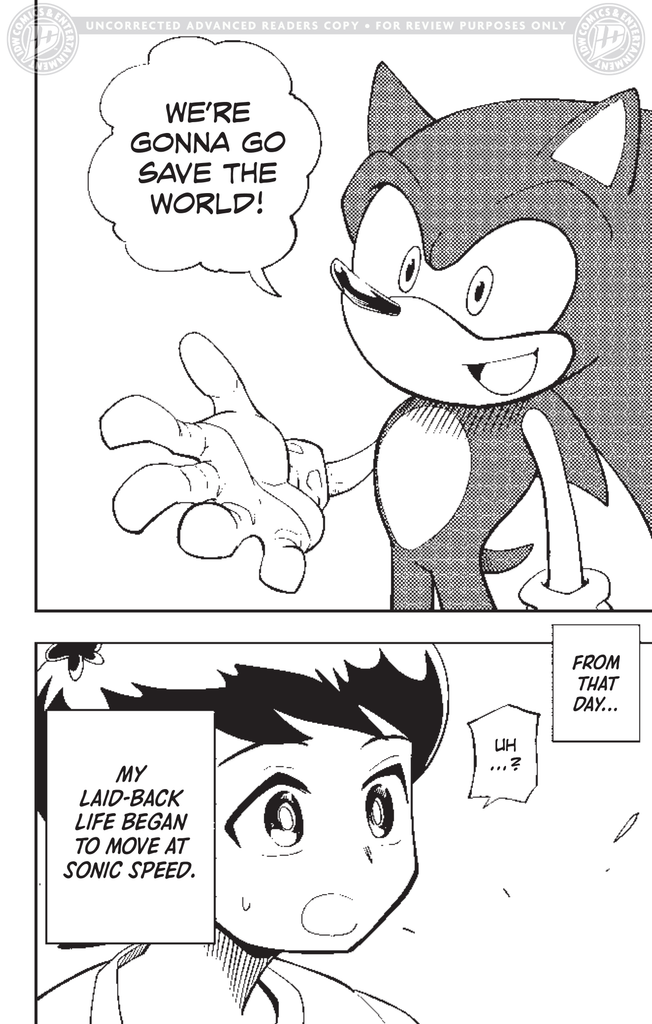
Back at Yuta’s home, Sonic finally explains why he has been hanging around in the first place. Something considerably worse is happening, the Blade of Courage may be important, and Sonic intends to do something about it.
His proposal is characteristically detailed and carefully considered:
They are going to save the world.
Yuta’s formerly laid-back life is about to start moving at Sonic speed.
That is a strong first chapter. The Blade of Courage does not reinvent Sonic storytelling, but it does something more important for an opening chapter: it gives us a new relationship worth following. Yuta is sympathetic without being helpless, his “slowpoke” gimmick feeds directly into both his personality and his powers, and Sonic feels recognisably like the adventurous, instinctively heroic troublemaker he should be.
Most importantly, the manga takes what initially sounds like a goofy contrast between the fastest thing alive and the slowest kid in the world and turns it into the entire thematic backbone of the story.
Turns out Sonic did not need somebody who could keep up with him.
He needed somebody who knew when to slow things down.

A funny, energetic and unexpectedly heartfelt start that gives Sonic a promising new partner and finds a clever way to make “slow” every bit as useful as “fast.”
Discover more from Sonic City ⋆★ Sonic the Hedgehog News, Media, & Community ★⋆
Subscribe to get the latest posts sent to your email.